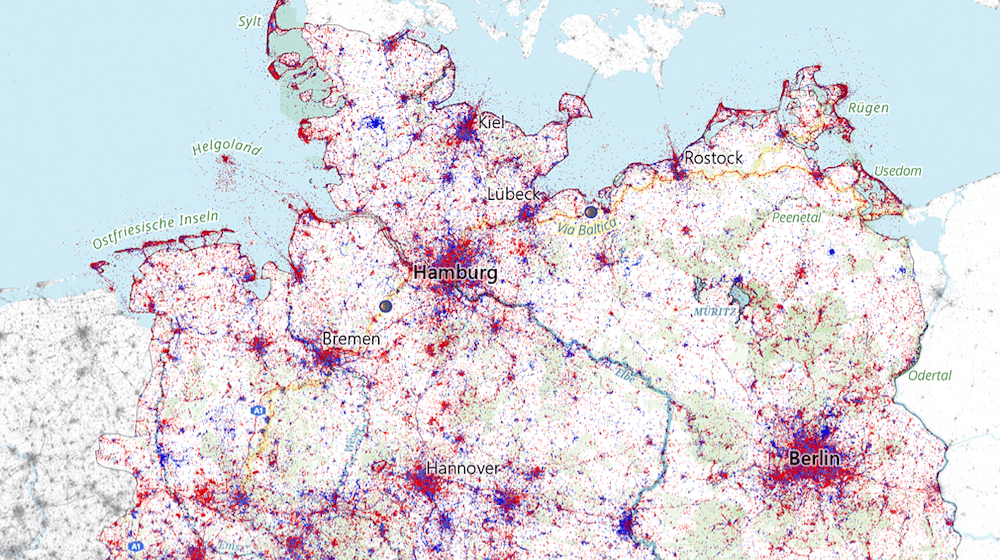
Posting a photo of a hiking trip on Instagram or sharing a picture of nature on Flickr leaves behind digital traces. These traces reveal a lot about which places people particularly appreciate. Researchers from the Leibniz Institute of Ecological Urban and Regional Development (IOER) in Dresden, together with Prof. Catrin Schmidt from the Institute of Landscape Architecture at TU Dresden, have analyzed 66 million social media posts. The result is a map that shows where locals go to relax and which destinations tourists head for.
The data basis is impressive. Over 15 years, the scientists collected posts from platforms such as Flickr, Instagram, Twitter and iNaturalist. Each post contained GPS data that revealed the exact location. "The map paints a diverse picture of how space is used," explains Alexander Dunkel from the IOER. In large cities such as Berlin or Munich, red dots dominate. They represent tourists who report on places of interest. On the outskirts of cities and in the surrounding countryside, blue dots predominate. This is where the locals are active, relaxing in nature.
Saxon Switzerland attracts visitors
Clear patterns can also be seen outside the cities. In rural regions, it is mostly locals who post. But tourist hotspots stand out. The Harz Mountains, Saxon Switzerland, the Elbe Cycle Path and the coasts attract many visitors. Their posts leave red marks on the map. This information is valuable for planning. They show where natural areas could be impacted by too many visitors. What goes viral on Instagram often leads to an onslaught in reality.
The researchers see even more potential in the data. "The new findings could close a gap between the goals of public planning and the lived reality of the population by making the subjective appreciation of the population visible in detail and across the board," says Dunkel. This would enable planners to better understand which places are really important to people. This enables planning that is closer to the needs of the population.
Data protection is a top priority
The use of social media data raises questions about data protection. The researchers have taken care to protect privacy. They only work with anonymized and summarized data. Individual posts can no longer be traced back. The data and the methods used to analyze it are available to other researchers. They are available in the IOER's research database. The study was published in the December issue of the journal "Naturschutz und Landschaftsplanung".
Original publication
Dunkel, Alexander; Schmidt, Catrin; Wende, Wolfgang; Nieswand, Maria:
Digital traces in the landscape. A new look at natural spaces through social media. [Part of the series "Landscape and Nature in Maps" edited by Walz, Ulrich (HTW Dresden); Wende, Wolfgang; Meinel, Gotthard (both IÖR)] In: Nature conservation and landscape planning. Journal for applied ecology. 57 (2025) 12, pp. 38-39.