
 (The podcast is in German)
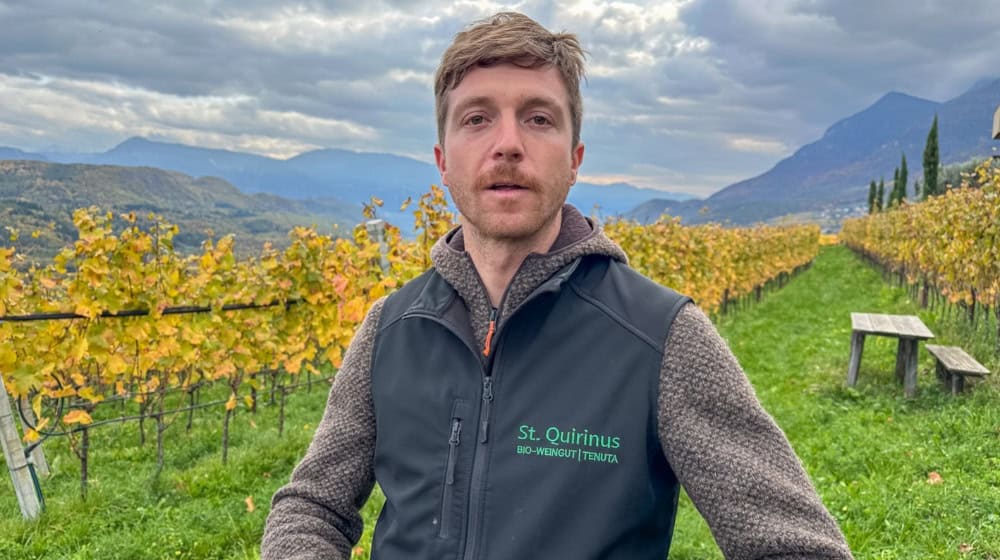
The South Tyrolean winery St. Quirinus is one of the younger wineries in the region, which also has a wine-growing tradition dating back thousands of years. I met the winemaker Michael Sinn in Oberplanitzing, a district of Kaltern on Lake Kaltern. The young family business, which started growing grapes on the farm in 2009 and began producing its own wine in 2013, now produces almost 60,000 bottles a year and cultivates almost 10 hectares of vineyards at an altitude of between 230 and 700 meters. St. Quirinus stands for biodynamic cultivation (Demeter-certified since 2013), which means minimal plant protection and a high PiWi share of 25-33 percent. The rest of the winery's range (which is larger overall, of course) combines international grape varieties with regional classics.
Sauvignon Blanc, Pinot Noir and Pinot Blanc are partly vinified according to site and reflect the diversity of the locations. At the same time, the cultivation of traditional South Tyrolean varieties remains an important concern. Vernatsch - the historic grape variety of the Kalterer See region - continues to play an important role. In the past, Vernatsch was often focused on high yields and simple qualities, but today Michael Sinn, like many younger wineries, focuses on reduced quantities and careful vinification. The resulting wines are lighter, fruity and delicate, but have significantly more structure and expression than previous generations. The traditional red Lagrein variety is also an important pillar of the business. A contiguous vineyard north of Lake Kaltern, partly planted with Pergola vines over 60 years old, provides the basis for a dense, intensely colored Lagrein with supple tannins. In addition to traditional pergola cultivation, younger vineyards are increasingly being cultivated using the Guyot system in order to control yield and ripeness development more precisely. Harvesting is always done by hand, as is customary in South Tyrol due to the small-scale structures of many vineyards.
Wine growing since Roman times
The area around Kaltern has been documented as a wine-growing region since Roman times; in the Middle Ages, the Benedictines of the Tegernsee monastery, among others, cultivated large parts of the surrounding hills. The name of the winery commemorates St. Quirinus, patron saint of the monastery and historical reference point of the region. The history of today's winery began comparatively late. Although farming has been part of everyday life in the family of winemaker Michael Sinn for generations - with fruit growing, livestock farming and small vineyards - the grapes were delivered to the Kaltern winery for a long time, as was traditional in South Tyrol. It was only with the construction of the new farm in 2009 that the basis for an independent winery was created. Since 2013, the wines have been vinified and marketed entirely in-house. Production has grown from around 8,000 bottles to around 60,000 bottles a year within just a few years.
The winery now cultivates almost ten hectares of vines, spread over several plots, some of which are widely separated from one another, at altitudes between around 230 and 700 meters. Although this dispersion poses organizational challenges, it also allows for a great diversity of soils, microclimates and grape varieties, which is reflected in the range. Some of the vineyards are located in special cold air zones, where significant temperature differences can occur within a few meters - a factor that has a noticeable influence on the ripening process and aroma of the grapes.
Sustainability plays a major role
Sustainable viticulture plays a central role in the company's philosophy. The family switched to organic farming back in 2006 and later converted to biodynamic methods; the winery has been Demeter-certified since 2013. At the same time, a conscious decision was made to use fungus-resistant grape varieties (PIWI), which require significantly less plant protection. While five to eighteen tractor passes may be necessary in traditional vineyards, depending on the weather, the treatment effort for PIWI varieties is often limited to one to three passes per year. Today, these grape varieties account for around a quarter to a third of the vineyard area.
St. Quirinus also pursues a differentiated approach in the cellar, where different ageing vessels are used specifically to produce different styles. In addition to stainless steel tanks and wooden barrels, clay amphorae have also been used for several years, some of which are free-standing and others - following the Georgian model - embedded in the ground. The different oxygen permeabilities of the vessels make it possible to develop wines with varying textures and aroma profiles. Particularly characteristic results are achieved by ageing in amphorae, such as the Orange Wine from Souvignier Gris, which is fermented on the skins for several months and thus gains structure, tannin and an independent aroma.
The expansion of the cellar in recent years has created the technical basis to consistently manage the growing production in terms of quality. Despite the modern infrastructure, the business remains strongly family-run: In addition to Michael Sinn, his father, a few permanent employees as well as seasonal workers and interns work together in the vineyard and cellar during the harvest.
The most important sales market continues to be in South Tyrol itself, where the wines are sold both from the farm and in restaurants and wine bars - including two of the company's own establishments in Kaltern. The range is moderately priced, from classic lines in the entry-level segment to selected site wines and smaller top bottlings. The aim remains to offer high-quality, handcrafted wines that remain affordable for a wide audience despite rising production costs.
The wines tasted
- St. Quirinus Brut Rosé
- 2024 Planitzing Sauvignon
- 2021 Planties Amphora
- 2023 Quirinus Kalterer See Classico Superiore
- 2023 Badl Lagrein
Infos
St. Quirinus
Oberplanitzing 4b
I-39052 Kaltern (BZ)
Tel: +39 335 540 62 63
st-quirinus.it
[Visited on October 27, 2025]
Note:
The research trip to South Tyrol was supported by theiner's garten das biorefugium