

loading

Nachrichten werden geladen...

News zu #Max Planck Society

Where are you looking? Children around the world understand gaze directions in the same way - a study from Leipzig shows. © AI-generated with ChatGPT

Children all over the world "read" gazes in the same way

How do children understand where others are looking? Researchers at the Max Planck Institute in Leipzig have studied 1,377 children from 14 countries. Their findings reveal a universal thought process that works in the same way all over the world. However, the study also reveals surprising differences between individual children.

Researchers in Leipzig have shown that chimpanzees can act sustainably if they live in larger groups and treat each other with tolerance. © pixabay/Marcel Langthim

Chimpanzees share better in a group

Can apes think sustainably? Researchers at the Max Planck Institute in Leipzig have given chimpanzees a tricky task: Snack on yogurt or save it for the group? The result is surprising. Larger groups act much more cooperatively than pairs. The decisive factors are tolerance and the behavior of the leader. The findings could also be relevant for human societies.

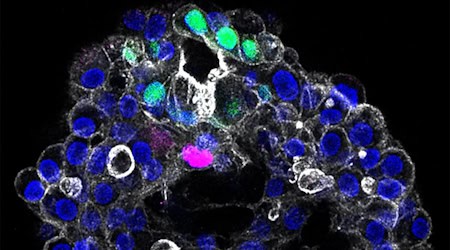
The mini-liver from the petri dish, with the three most important cell types of the liver: portal fibroblasts (magenta), cholangiocytes (green) and hepatocyte nuclei (blue).  Lei Yuan, Sagarika Dawka, Yohan Kim, Anke Liebert et al. / Nature (2025) / MPI-CBG

Mini livers from the petri dish to help patients

Over two million people die of liver disease every year. Researchers at the Max Planck Institute in Dresden have now developed a three-dimensional liver model from real patient cells. The mini-liver can mimic important functions and should help to better understand diseases, test new drugs and develop personalized therapies. The study was published in Nature.