They were once considered a cure for a wide range of ailments. Today, scientists from Saxony are using high-energy X-rays to shine a light into their inner world. We are talking about Saxon sealing clays from the 18th century - pressed clay plates that were once sold as a remedy. What exactly they contain has hardly been researched to this day. A team from TU Bergakademie Freiberg set out to find out.
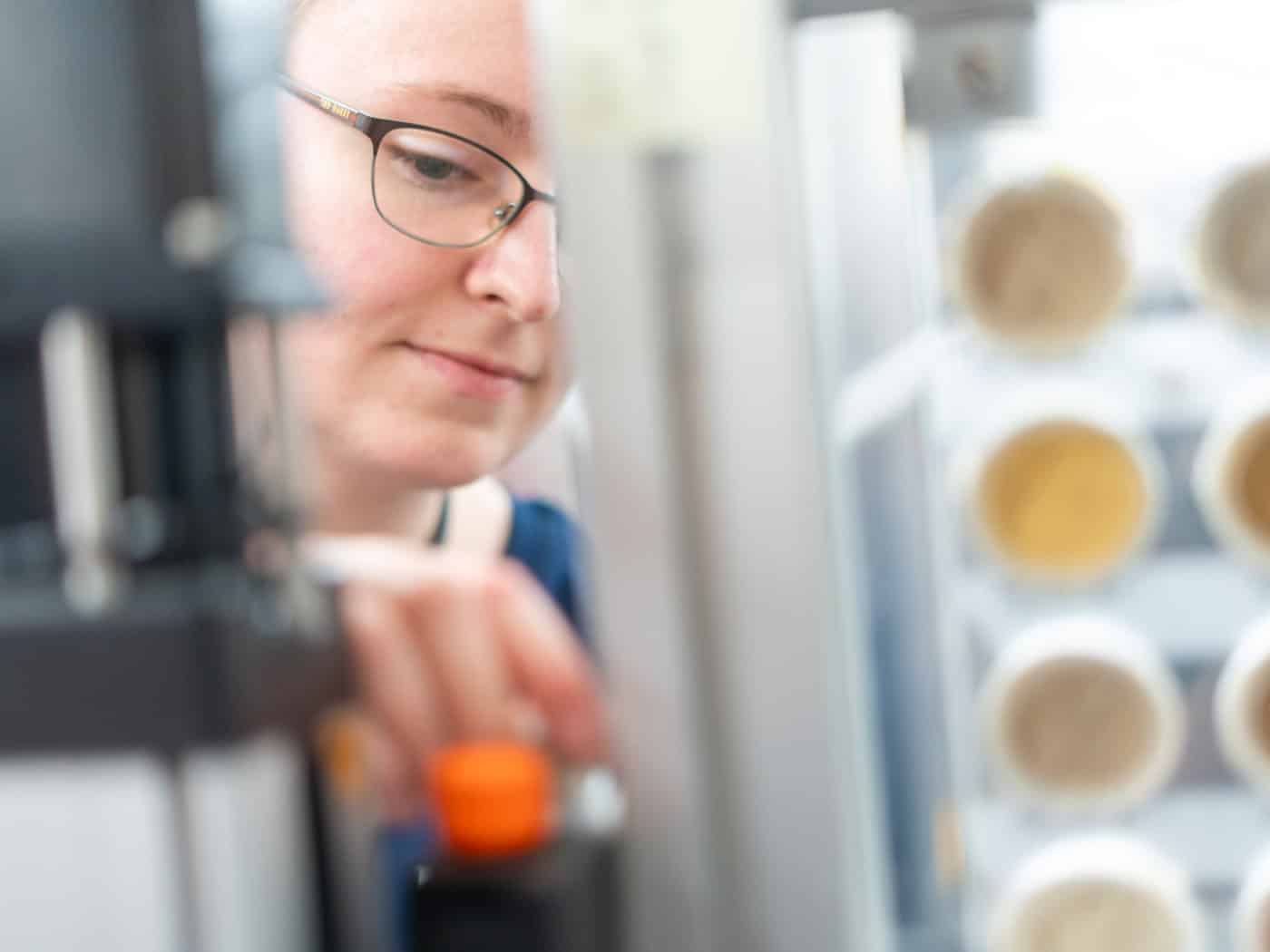
To do this, PhD student Anja Weber, Prof. Gerhard Heide and several Master's students traveled to the Deutsches Elektronen-Synchrotron (DESY) in Hamburg. DESY is one of the world's leading particle accelerator centers and is part of the Helmholtz Association, Germany's largest research network. There, huge machines accelerate electrons almost to the speed of light, generating extremely powerful X-rays. These make even tiny crystal structures in old pieces of clay visible.
From the lecture hall directly to the large-scale machine
For Master's student Sebastian Moritz, it was a special moment. "I didn't expect that this would soon be practically relevant for me when I was actually there in Hamburg for the first time. I was immediately fascinated!"
His fellow student Nele Jensen describes how the team grew together in day and night shifts. "We complemented each other well with our different strengths: some are very skilled at fitting the sample holders, others keep track of the work steps or stay calm if something goes wrong. That gives us confidence." In addition to the measurements, the students also learned how to plan experiments precisely, carry them out according to strict specifications and deal with incorrect measurements. Experience that extends far beyond the lecture hall.
What the X-ray beam reveals in old clay plates
The historical clay objects are called "Terra Sigillata" in Latin - sealed earth. They were widely used from antiquity to the 18th century as remedies, trade goods and collector's items. The Saxon variants have hardly been studied to date.
At DESY, the X-ray beam hits the tiny crystal lattices in the clay minerals. The rays are scattered by the crystal structures and create a characteristic diffraction pattern. "From this, we can determine which minerals are contained - and ideally in what quantity," explains Anja Weber. Her doctoral thesis is the first systematic study of its kind. The aim is to draw conclusions about where the objects were found and how they were made.
A strict condition applies. "These are historical, museum cultural assets that may only be analyzed non-destructively - as is possible at DESY," says Weber. "I think this form of connection through research is particularly valuable," says Gerhard Heide, summarizing why such excursions are valuable.