


The podcast is recorded in German!
Till Neumeister is head of viticulture at Staatsweingut Schloss Wackerbarth and thus responsible for the 90 hectares of vineyards that provide the basis for around 600.000 bottles per year - around 350,000 bottles of still wine and 250,000 bottles of sparkling wine in classic bottle fermentation. In November last year - shortly after the harvest - we recorded this podcast episode in which we taste two sparkling wines and two still wines that have what it takes to surprise. Many wine connoisseurs still do not associate Wackerbarth products with top sparkling wines or top wines. But they have probably never tasted a Bussard sparkling wine or a Protze Riesling...
The fact that wine is created in the vineyard is an oft-used formula. A beautiful formulation for precise work: For sparkling base wines in particular, the time of harvest determines style and quality. The grapes are harvested earlier than for still wines to ensure precise, ripe acidity and moderate must weights. In warm years, this can begin as early as the end of August; 2018 was an extreme case with very early flowering and a correspondingly early harvest. Pinot Noir from the warm Radebeul vineyards then often forms the prelude - including for top sparkling wines such as Bussard or Blanc de Noir.
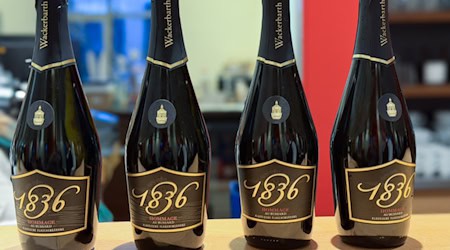
We start with a - literally - excellent sparkling wine: it is called 1836, which is a practical name: you know when sparkling wines started in Saxony, namely 190 years ago. Last summer, Meininger named 1836 the best dry sparkling wine in Germany. This is an honor for the state winery, but also great for consumers, because at € 17 in the winery's store, this cuvée is actually a basic sparkling wine. The "Cuvée Tradition" consists mainly of Riesling, supplemented by a (quite considerable, depending on the vintage) proportion of Pinot Blanc and a small dash of Scheurebe.
It's all about the logistics
Logistics are part of the quality philosophy, especially when it comes to sparkling wine. Grapes must be processed cool and fast. Wackerbarth works with special harvest wagons based on the Champagne model; grapes are harvested in the early hours of the morning or at night. Refrigerated vehicles are available in the vineyards. Dry ice is not used - instead, the focus is on organization and speed. For top-quality material, the grapes are sometimes only harvested for two hours a day, over several days. It is better to have 25 people concentrated for a short time than a small team over several days. The aim is to harvest with almost pinpoint accuracy in terms of acidity and pH value. The ideal pH value for sparkling wine is lower than for still wine; the most important thing is that the acidity is physiologically ripe. Unripe acidity tastes green and vegetable-like - a style that Neumeister categorically excludes.
The meticulousness continues in the cellar. The minimum legal requirements - nine months on the lees - do not play a role in the quality segment. As a member of the Association of Traditional Sparkling Wine Makers, Wackerbarth is committed to significantly longer maturation periods. Two to three years on the lees is common for many sparkling wines, with individual batches maturing for longer. The aim is a classic style with a fine perlage and brioche notes. The simpler sparkling wines using the transvasation method are produced externally; classic bottle fermentation remains the core competence in-house, where Christiane Spieler is responsible for sparkling wine production and Jürgen Aumüller is in charge of oenology - both have been influential figures in the company for many years. The sparkling wine industry, Neumeister emphasizes, is manageable; people know each other, exchanges take place at eye level.
Historically, Wackerbarth is in a special position. The estate is one of the oldest sparkling wine producers in Germany and - along with its predecessors - the oldest in Saxony. As early as 1836, three vineyard owners from Radebeul invested 100,000 thalers in the founding of a sparkling wine factory. Their cellar master, Johann Joseph Mouzon, came from Reims and brought with him the know-how of Champagne. This tradition gave rise to the "Bussard", today the house's top product. The brand has been integrated into Wackerbarth since 1972.
The Bussard is a cuvée of Pinot Noir and Pinot Blanc (Pinot Blanc), supplemented for some years by reserve wines - this also has its model in Champagne. A small proportion of Pinot Gris in the Reservé is reminiscent of early blends. The minimum ageing period on the lees is three years; individual batches mature for considerably longer. The Bussard in our glasses spent 42 months on the lees. The grapes come from the Johannisberg vineyard in Radebeul, the Kynast plot, as well as from the Laubacher Thonberg monopole vineyard in Diesbar-Seußlitz.
Neumeister believes that the Saxon growing region is predestined for high-quality sparkling wines: a continental climate with cool nights, differentiated soils - from loess loam to volcanic weathered rock - as well as historically a lot of experience with sparkling wines. Nevertheless, the quality of the sparkling wines is (too) little known outside the region. In the GDR era, there was a lack of international exchange at a top level - and in the post-reunification period, regional demand was strong enough, which made an offensive external presence unnecessary.
Stillweine von Alten Reben und aus der Protze
One example of the independent signature in the vineyard is the "Alte Reben" from the Goldener Wagen. The terraces were planted with different varieties in 1950 - including Traminer, Riesling, Pinot Gris and Silvaner. Legally, this cannot be referred to as a "Gemischter Satz" today; however, the historical site is protected. For Neumeister, the challenge lies in the time of harvest: experience and intuition are more important than analytical data. The wine changes dynamically in the glass, showing salty minerality without heaviness. In the Goldener Wagen, Wackerbarth only cultivates steep and terraced sites, a total of 4.8 hectares within the 25-hectare single vineyard. The vineyards have been herbicide-free for ten years; the flora and fauna have visibly recovered. Plant protection using drones is currently being tested. Preserving the cultural landscape is part of the self-image.
One of the plots that Till Neumeister particularly appreciates is the Protze, an exposed, wind-open area with vines that are around 30 years old. The yields are extremely low at 10 to 15 hectoliters per hectare. The grapes are harvested in small crates, gently pressed, the must fermented spontaneously and matured in stainless steel. The result: a Riesling with a clear structure and high consistency, harvested almost exactly around October 3rd each year. A maximum of 900 bottles are produced.
Whether sparkling wine or still wine, Neumeister's approach remains the same: precise work in the vineyard, close monitoring of ripening parameters, uncompromising selection. When asked about expanding production, he responds realistically. Neither wine nor sparkling wine can fully meet demand. Space capacities, vintage fluctuations and the high cost of classic bottle fermentation set natural limits. Quality defines quantity - not the other way around.
Podcast tasting
- 1836 Hommage au Bussard
- Bussard Royal - Hommage Monsieur Mouzon, Réserve
- 2023 Alte Reben, Goldener Wagen
- 2023 Riesling Protze, Goldener Wagen
Some jumping off points of our conversation
[00:00] Our guest comes from Schloss Wackerbarth: Till Neumeister
[00:44] Does it pop or fizz? In the glass: 1836 - an "excellent sparkling wine"
[03:19] Start of work!
[11:51] Wine is made in the vineyard (and then, of course, there's the cellar work). But what is special about grapes for sparkling wine?
[25:17] We come (already!) to the top product: Buzzard
[45:45] Before we continue, Buzzard again!
[50:11] in the glass: Old vines from the Goldener Wagen - from the slim magnum
[55:43] Goldener Wagen: Wackerbarth has 4.8 ha there
[1:00:01] Mastermind in the background: Janek Schumann (podcast episode 52 guest)
[1:08:14] wine from Matthias' favorite parcel flows into the glass: Protze
Schloss Wackerbarth
Wackerbarthstraße 1
01445 Radebeul
Tel. +49 351 89550
[Recorded on November 20, 2025]
.