The restaurant Das Palais in the Kempinski Taschenbergpalais is a sophisticated place. Perfect service is part of this, even if it sometimes seems a little old-fashioned and stiff: the waitress could simply address you as "Sie" and look at you, or even (as in the Adlon, also a Kempinski) address you by name - everyone has a reservation, so it wouldn't be rocket science. But instead you prefer "The gentleman! The lady!" and ask, no longer quite so aloof and already a bit of a takeover: "Shall we try the wine now?" For heaven's sake, no, not us! I want to taste it alone! I didn't mean it like that with the "we" - but who knows, maybe next time I'll just reply: "I'd love to, why don't you join me?"
The culinary start to the evening begins with a playful gimmick. A green shot stands on a square, solid-looking wooden box, next to it is a stylish bowl with a little something on top as a kitchen greeting - a hint of early spring, because with crayfish and kohlrabi, a Leipziger Allerlei is already quoted, for which we still have to wait two or three months (if everything is to be fresh). But then! The waiter pushes the lid aside, pulls out a drawer at the bottom and there's a secret compartment hidden in the open lid - et voilá: Spread, bread and salt are available. Very nice and a great idea, even if the one salt has obviously not been moved for a long time: it was stuffed in the tube. Pro tip: poke it with a needle from time to time and loosen it up! The bread and spread were of the "unfortunately sooo good" variety that there was nothing left over. The service offered to add more - but common sense kicked in and whispered: "Look, there's more to come. Does it have to be?"
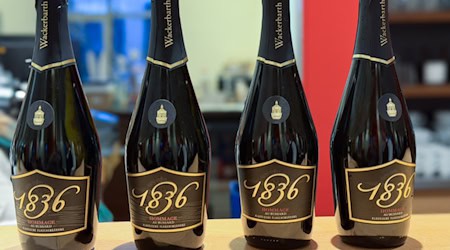
With this, reason was also exhausted and withdrew when it came to the question of wine accompaniment: of course, of course, full program! This is worth mentioning because three of the five wines were from Saxon winegrowers selected by the team. That's remarkable and also nice when you consider that knowledge of local wine tends to be virtually non-existent throughout Germany - and even those who know that there is wine here often don't believe that you can or even should drink it. We could go on and on about the selection of winemakers and wines, but that's getting into nerdy detail.
Wines from Saxony - there's even a red one
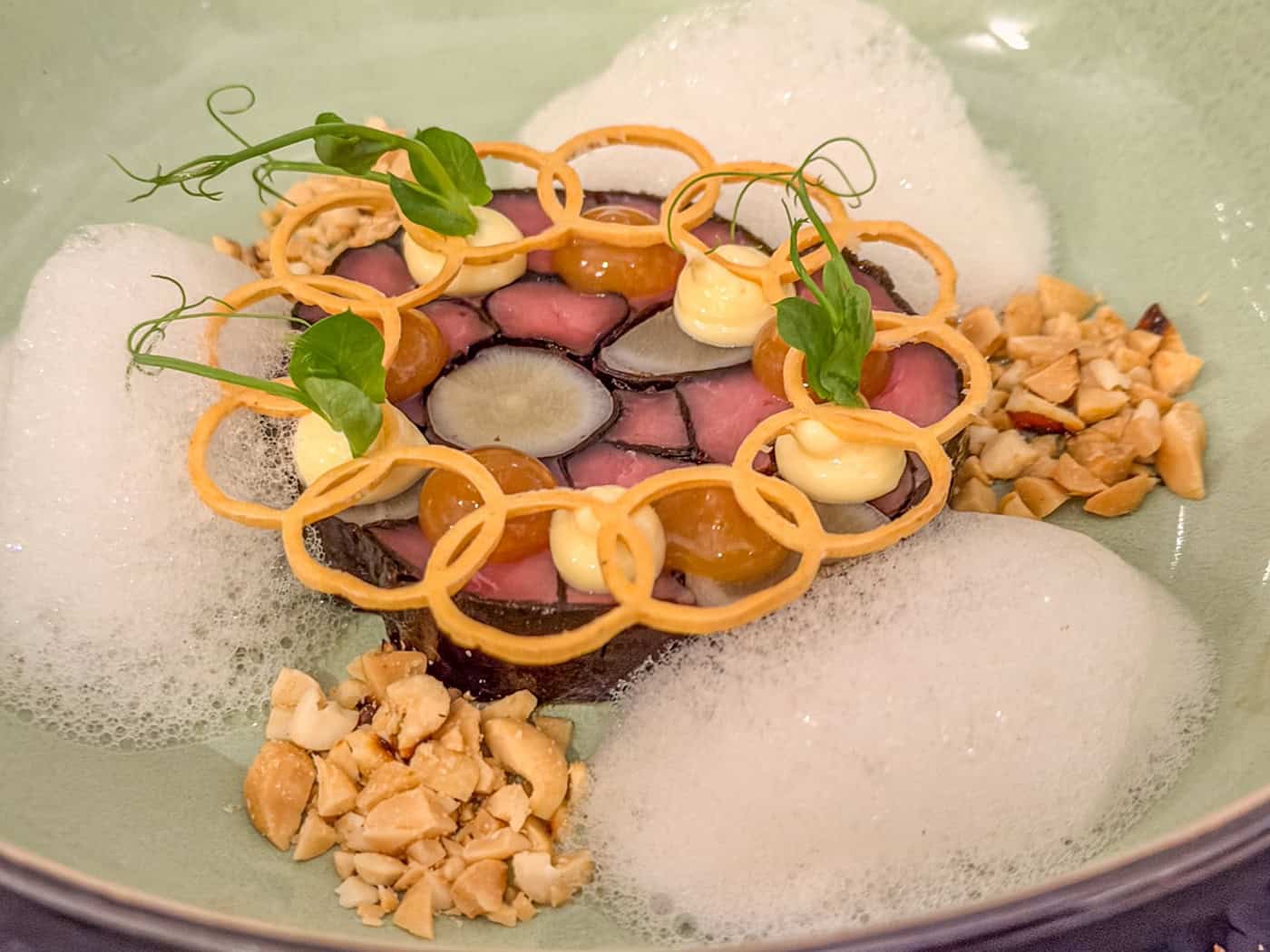
For starters, we had a Regent from the Matyas winery from the 2022 vintage - so not quite so young anymore. This was a double or triple surprise for the tourists at the next table because, firstly, they were not so familiar with Saxon wine, secondly, they were surprised to hear "oh, there's red wine here too!" and thirdly, they had obviously never consciously had Regent in their glass before. After all, you'd rather order a Taittinger than a Regent with confidence and style! Even winegrowers and sommeliers sometimes don't believe that a fifth of all vines in Saxony are red wine varieties, and nobody knows that about half of the (few) new plantings in recent years have been red varieties (well, they do now...). The duck, which was the main component of the mosaic artfully held together by nori seaweed (except for the duck: black salsify), was a perfect match! Incidentally, the plate had been arranged with all kinds of peanuts, tamarind, orange and an airy ginger foam to create a wonderful picture, almost too beautiful to eat...
The soup was unspectacular, despite the salmon in a pastry coat on the edge of the plate, both visually and in terms of taste, because it was almost a little too salty for me. And how to get the salmon elegantly off its wooden skewer was also beyond me. If gimmicks prevent you from eating without accidents, perhaps you should reconsider them. And no, I hadn't had too much wine by then! Pouilly-Fumé, a quiet Sauvignon Blanc with the typical flinty minerality, is sometimes not ordered simply because you don't want to stumble over the mispronunciation of the name - but you can always order the da! plus point to the menu or the great Sauvignon Blanc! Either way, if you like the loud New Zealand version, you'll despair here, but if you don't like those from Down Under, you'll be delighted.
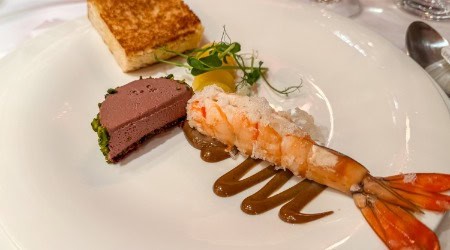
In classic French cuisine, you learn: never use exactly the same sauce! Not even the same main ingredient! But now there was something on the spoon again! This time, however, it's a good argument and easy to solve with a knife and fork: Magnum from the Faux Gras. It looked like ice cream, was supposed to taste like foie gras and was actually just faux. The balance between ethics and cuisine is difficult to maintain, and the attempt to come close to the original in terms of taste is as laudable as it is difficult. Benjamin Biedlingmaier, then head chef at the Caroussel restaurant in the Bülow Palais in Dresden, was able to produce a "faux gras" (i.e. "fake fat") in 2017 that was amazingly close to the original. But it's not quite so easy to tease creaminess and consistency out of cashew nuts. Seen in this light, the Magnum was a faux faux, but of course (if you don't have the comparison) an exciting lollipop, which was also nicely embellished with wafer-thin slices of green asparagus and small elderberry balls. Inspired by goose (foie) liver, the accompanying wine was slightly sweetened: a Riesling Kabinett from Matthias Schuh, which came very close to the Kabi model from the Moselle in terms of lightness.
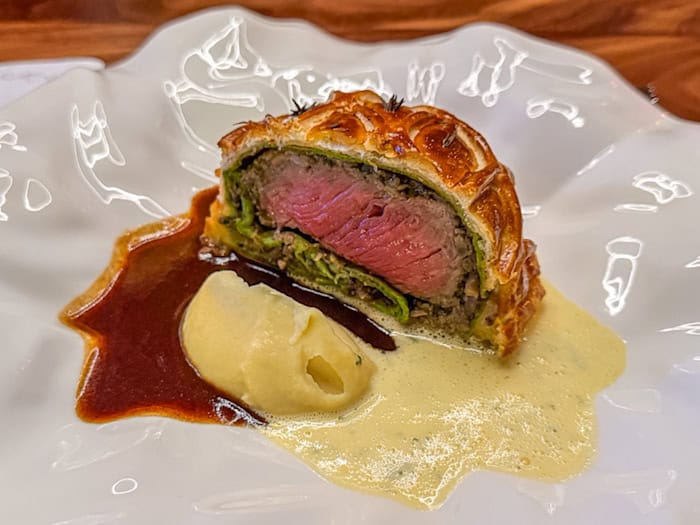
For the main course, the service promised a sauce that wouldn't spill on your trousers. I wanted to be upset that I was implicitly being denied the right to eat without spilling, but I swallowed my short-term resentment with a glass of the Rioja that had already been poured. The truth is that between the flank steak (cooked to the point of pink) and the sweet potato shaped like a flank steak (crispy on the outside, soft on the inside), the kitchen had completely reinterpreted the word sauce. The sauce was firm to the bite. As soon as the waitress had left, I had to reach for the glass again and take a bigger sip: What the agar-agar is that supposed to do, make a tasty sauce solidify so that it (perhaps, if you're lucky) melts again in your mouth? Of course you could (even I old man could) cut and eat it without an accident - but enjoy? Come on, pour my glass once more with that beautiful red wine (freely adapted from Reinhard Mey, because the Gran Reserva wasn't cheap like the wine sung about in the original). But I had to hark back to the days when a sauce was still a sauce.
The last flap: dessert. Cold dog, but of course not as you know it, but laid flat. With greetings to the gentlemen from the next table (we had talked and exchanged a little table-to-table during the evening), who are now allowed to think about Saxony deep in the west again: it almost looked like the faux sauce, but tasted better. And: they were also able to learn an important lesson for the Saxon wine landscape, including a final surprise effect. There was a dry Traminer Spätlese from the Drei Herren. With a rose on the nose and then surprising filigree on the palate.
Menu
- Starter
Mosaic of duck and black salsify: tamarind | orange | nori seaweed | peanut - Soup
Dashi: salmon | mussel | calamansi | herbs - Intermediate course
Magnum of faux grass: Cashew | Green Asparagus | Tomato | Elderberry - Main Course
Roasted Flank Steak: Kalettes | Verbena | Almond | Herbs | Potato - Dessert
Cold Dog: Chocolate | shortbread | pear
Wine pairing
- Starter
2022 Regent, Matyas Winery, Saxony - Soup
2023 Pouilly-Fumé, Jean Pabiot et fils, Loire, F - Intercourse
2024 Riesling Kabinett, Weingut Schuh, Saxony - Main course
2016 Gran Reserva, Ramon Bilboa, Rioja, ES - Dessert
2023 Traminer Spätlese, Weingut Drei Herren, Saxony
Info
- 3-course menu: Soup | main course | dessert €63 | incl. wine pairing €98
- 4-course menu: Appetizer | Soup | Main course | Dessert 73 € | incl. wine accompaniment 120 €
- 5-course menu 85 € | plus wine accompaniment 144 €
Das Palais
Taschenberg 3
01067 Dresden
Tel. +49 351 4912710
kempinski.com
[Visited on February 27, 2026]