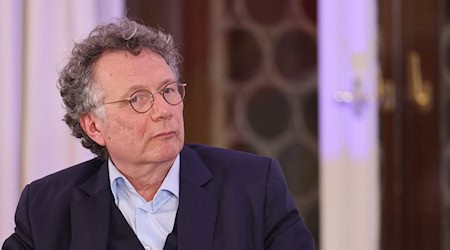

If you ask Stephan Seeger, Managing Director of the Sparkasse Leipzig Media Foundation, about the writer Erich Loest (1926-2013), his verdict is clear: "He is still very present in Leipzig. But in the general public, in the general public at large, it has become quiet, and he doesn't deserve that."
The Media Foundation is taking Loest's 100th birthday on February 24 as an opportunity to present a special edition of an award named after him. The Erich Loest Prize, endowed with 10,000 euros, will go to the Dresden-born writer Durs Grünbein on Tuesday.
The prize is awarded every two years, with the next regular award ceremony scheduled for 2027. According to the foundation, the prize honors people who, like Loest, are openly - and often controversially - committed to democracy.
Book with Loest's correspondence
A new book with Loest's correspondence will also be presented. It was sponsored by the Media Foundation. "Erich Loest "Mensch, was haben wir alles hinter uns"" contains correspondence that the honorary citizen of Leipzig had with a wide variety of personalities from 1953 to 2013.
It begins with letters to his wife Annelies from the Stasi prison in Bautzen, where he was held for seven years from 1957 for alleged counter-revolutionary activities. This is followed by correspondence with numerous authors from the GDR such as Walter Janka and Christa Wolf, as well as exchanges with authors from West Germany such as Walter Kempowski and Günter Grass.
German division and reunification as life themes
"This correspondence shows how highly regarded Loest was among writers," says historian Seeger. Loest, who moved to West Germany in 1981 and returned to Leipzig after the peaceful revolution, was a German-German writer. The division of Germany and reunification were major themes in Loest's works, such as the novel "Nikolaikirche".
The Cultural and Environmental Foundation of the Stadt- und Kreissparkasse Leipzig is the custodian of Loest's estate. The writer bequeathed hundreds of letters, manuscripts and handwritten notes to the foundation - the equivalent of more than 110 Leitz folders. A selection of these letters has been included in the new book.
Foundation director Seeger would like to see the book used in school lessons in the future. "Anyone who wants to get a picture of the past 80 years of German history and also wants to understand something of the changes that also took place in the GDR can do so with this book based on this correspondence," he says.
Copyright 2026, dpa (www.dpa.de). All rights reserved