
Roast goose, twinkling lights, "Oh Du Fröhliche": Christmas in the GDR was in many ways not so different from the way we celebrate today. Nevertheless, there were a few things that made the celebration different in the workers' and peasants' state. And some classics live on in reunified Germany.
Christmas as a collective
Christmas was celebrated as traditionally in the immediate family circle as it was before the GDR and still is today, says Klaus Horn (74). He is the director of the GDR exhibition "Deudera" in Erfurt. "The biggest difference was probably that Christmas wasn't just spent with the family, but was celebrated more broadly, more generally."
Particularly in companies, but also in sports and women's associations, celebrations were organized. Horn: "It was an unwritten law: there was no collective - today we would call it a team - that didn't have a Christmas party."
Gifts back then were not as expensive as they are today. "The focus was more on individuality," says Horn. A lot of homemade gifts were also given.
There used to be more tinsel
"There used to be more tinsel" - the famous line from a Loriot sketch also applied to the GDR. And the mostly silver tree decorations, produced by VEB Thüringer Glasschmuck Lauscha, were made of aluminum foil. Because the tinsel was more crinkly than is usual today, it didn't slip off the needles of the tree as easily.
Care was then required when decorating the tree: because the GDR was not exactly a society of abundance, many families collected thread by thread from the tree and carefully sorted it back into the cardboard packaging - for the next year.
About the tree
Norman fir or blue spruce, bushy or slender, from the supermarket or from the fir farm? People in the GDR were not spoiled for choice. It was much more a question of getting a tree that had grown reasonably straight and had enough greenery.
If this didn't work, the story goes: make two into one. Holes were then drilled into the trunk of one tree and the sparse splendor was filled in with the branches of the other.
Classics on television and on the turntable
A long-running hit on GDR television ran for 34 years on Christmas Day: the show "Zwischen Frühstück und Gänsebraten" (Between Breakfast and Roast Goose) brought a mixture of music, dance and sketches into living rooms between 11.00 am and 1.00 pm. From 1957, Heinz Quermann (1921-2003) and Margot Ebert (1926-2009) hosted the show. The end of GDR television in 1991 also marked the end of the show.
Musically, the album "Weihnachten in Familie" was a must for many people. Pop star Frank Schöbel released it in 1985 with his partner Aurora Lacasa.
"Year-end wing figure" - really?
It's no secret that the SED leadership wanted to eradicate Christian symbols. They did not succeed, says exhibition organizer Horn. "These were aberrations by overzealous functionaries. They tried to reinterpret traditions in a socialist sense. It wasn't supposed to be called a Christmas party, but a year-end party. But nobody said that. If anything, they made fun of it," said Horn.
There is also a persistent legend that a Christmas angel was called a "winged year-end figure" in the GDR. There is no proof of this. In 2006, historian Bodo Mrozek came to the following conclusion in his research: "There is still no proof of the real existence of the socialist phantom word." Klaus Horn believes that the "winged year-end figure" is simply "nonsense".
Destructible: candle arches and Herrnhut stars
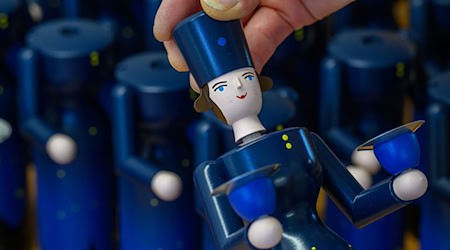
Folk art from the Erzgebirge and the shining Herrnhut stars from Upper Lusatia are not an invention of the GDR, but were very popular there. Nowadays, the items are sold nationwide and internationally.
In every major German city there is either a specialist store or a stand at the Christmas market where nutcrackers & Co are on sale, says Frederic Günther, managing director of the Association of Erzgebirgischer Kunsthandwerker und Spielzeughersteller. Every year, goods worth 150 to 200 million euros are sold to end customers. Herrnhuter Sterne GmbH expects to sell 850,000 stars this year.
"The best known worldwide is the nutcracker," says Günther. Pyramids, smoking men and candle arches are a little more special. "Sometimes you still have to explain them in the West."
Sind die Lichter angezündet
The GDR also added a song to the all-German Christmas carol canon: "Sind die Lichter angezündet" was written by the lyricist Erika Engel and set to music by Hans Sandig, director of the Rundfunk-Kinderchor in Leipzig.
In the three verses, there is no mention of the Christian background of Christmas, but the listeners are given a wish for peace in the last lines: "Shine, light, with a bright glow, everywhere, everywhere let there be peace."
Copyright 2025, dpa (www.dpa.de). All rights reserved